New York’s Legal Cannabis Market Surges, Offering a Glimpse of the Industry’s Scaled Future
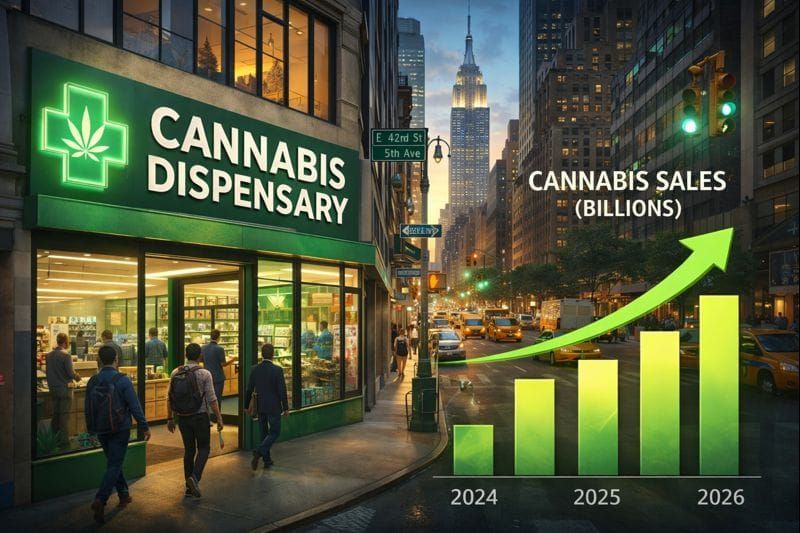
New York’s legal cannabis market crossed a symbolic threshold in 2025: it became big.
After a halting and often criticized rollout in its early years, the state’s adult-use cannabis industry posted its strongest growth to date, with licensed dispensaries expanding rapidly across the five boroughs and beyond. Cumulative sales climbed into the multibillion-dollar range, placing New York firmly among the world’s largest regulated cannabis markets.
For policymakers, investors, and regulators watching from abroad, the state now represents something new: a living case study of what happens when cannabis legalization moves from cautious experiment to large-scale commercial reality.
From Bottleneck to Boom
For much of its early life, New York’s cannabis program was defined by scarcity. Licenses were slow to issue. Legal storefronts were few. Unlicensed sellers flourished in the vacuum, undermining confidence in the system and frustrating both consumers and compliant operators.
That began to change in earnest over the past year.
State regulators accelerated licensing approvals, local governments relaxed zoning hurdles, and new capital entered the market. By late 2025, legal dispensaries had spread into neighborhoods that once relied almost entirely on unregulated sellers. The result was a sharp increase in legal access—and a corresponding jump in reported sales.
“This is what scale looks like,” said one industry analyst who tracks cannabis markets nationally. “Once density reaches a tipping point, consumer behavior changes quickly.”
Growth, With Complications
The expansion, however, has not been seamless.
Enforcement remains uneven, particularly against long-established illicit operators. While the state has increased raids and penalties, critics say the response still lags behind the pace of legal growth. Questions of public trust—who is regulated, who is not, and why—continue to shadow the industry.
At the same time, regulators are under pressure to prove that speed does not come at the expense of oversight. Product safety, advertising practices, labor standards, and community impact have all moved to the forefront as the market matures.
“This phase is harder than legalization itself,” said a former state regulator. “Building a big market is one thing. Governing it is another.”
Why the World Is Watching
New York’s importance extends far beyond its borders.
With its population size, economic gravity, and cultural influence, the state functions as a bellwether. When New York scales, capital reallocates. National brands adjust product lines. Supply chains shift. Investors recalibrate expectations for growth, consolidation, and profitability.
Perhaps more importantly, regulators elsewhere are paying close attention.
In Europe, Latin America, and parts of Asia, policymakers weighing cannabis reform are studying New York’s trajectory: the early stumbles, the political compromises, and now the acceleration. The lesson is neither purely cautionary nor celebratory. It is pragmatic.
Rapid licensing can unlock growth—but only if paired with credible enforcement and public transparency. Retail access can displace illegal markets—but only once it reaches sufficient scale. And social equity goals, often central to legalization debates, become harder to protect as markets grow faster and more competitive.
The Shape of What Comes Next
New York’s surge suggests that the global cannabis industry is entering a new chapter—one defined less by novelty and more by infrastructure, regulation, and endurance.
As the market grows, smaller operators may struggle. Consolidation is likely. Regulatory scrutiny will intensify. And the public conversation will shift from whether cannabis should be legal to how well legalization is actually working.
For now, New York stands as both proof of concept and cautionary tale: evidence that legal cannabis can scale rapidly in a major economy—and a reminder that growth, once unleashed, brings its own set of challenges.
The world’s largest cannabis experiments are no longer hypothetical. They are operating in real time, in real cities, with real consequences.